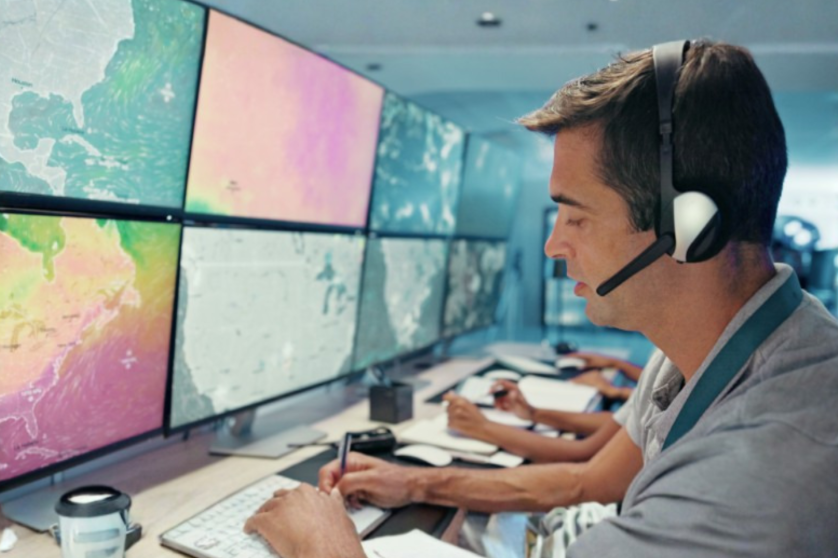
Forecasting is essentially a constant effort to predict how billions of changing environmental variables will interact across the planet.
Weather forecasts have become a routine part of everyday life. People check forecasts before commuting, traveling, planning outdoor events, or preparing for severe weather. Although modern forecasts often appear simple on weather apps or television screens, the science and technology behind how weather forecasts work are incredibly advanced.
Accurate forecasting depends on enormous global systems that continuously collect atmospheric data from satellites, radar stations, weather balloons, aircraft, ocean buoys, and ground-based sensors. Meteorologists then combine this information with powerful computer models designed to simulate how the atmosphere behaves over time.
How Weather Data Is Collected
Every weather forecast begins with observation. Meteorologists need massive amounts of real-time information about current atmospheric conditions before they can predict what may happen next.
Ground-based weather stations measure temperature, humidity, wind speed, air pressure, and precipitation. These stations are located at airports, research facilities, cities, and remote locations worldwide.
Radar systems are especially important for tracking precipitation and severe storms. Doppler radar sends out pulses of energy that bounce off rain, snow, hail, or moving particles in the atmosphere. By analyzing the returning signals, meteorologists can estimate storm intensity, movement, and rotation.
Satellites provide another critical layer of information. Orbiting satellites continuously monitor cloud patterns, storm systems, ocean temperatures, wildfire smoke, and atmospheric moisture across enormous areas of the planet.
Some satellites focus on visible imagery during daylight hours, while others use infrared sensors to monitor cloud temperatures and weather activity day and night.
Weather balloons are launched twice daily from hundreds of locations worldwide. These balloons carry instruments called radiosondes that collect atmospheric data high above the surface, including temperature, pressure, humidity, and wind conditions throughout different layers of the atmosphere.
Aircraft, ships, and ocean buoys also continuously contribute data, especially over oceans where traditional ground stations are unavailable.
See How Personal Risk Assessment Works for a related look at uncertainty.
How Computer Models Predict the Weather
Once observational data are collected, they are fed into numerical weather prediction models, extremely complex computer systems that simulate atmospheric behavior mathematically.
These models divide the atmosphere into millions of three-dimensional grid points. At each point, the computer calculates how variables such as temperature, pressure, moisture, and wind may change over time based on physical laws governing the atmosphere.
Because the atmosphere is constantly changing, forecasting models require enormous computing power. Supercomputers perform trillions of calculations to generate forecast simulations covering hours, days, or even weeks into the future.
Several major forecasting models are used globally. In the United States, the Global Forecast System, or GFS, is widely used. Europe’s ECMWF model is also highly respected for long-range forecasting accuracy.
Meteorologists compare multiple models because different systems may produce slightly different outcomes. Forecast confidence increases when several models agree closely.
Forecast models improve constantly as new observational data is added. This process, called data assimilation, helps update simulations and refine predictions throughout the day.
Read How to Read Statistics Without Being Misled for insight into forecast probabilities.
Why Forecasts Become Less Accurate Over Time
Weather forecasting becomes more difficult the farther into the future predictions extend. This happens because the atmosphere is an extremely dynamic and chaotic system where small differences can grow significantly over time.
Even tiny measurement gaps or minor shifts in atmospheric conditions can eventually produce very different outcomes days later. This concept is often associated with the “butterfly effect,” where small initial changes influence larger future patterns.
Short-term forecasts are generally much more reliable because atmospheric conditions have had less time to evolve unpredictably. Forecasts for the next 24 to 48 hours are usually highly accurate in many situations.
Long-range forecasts, however, involve greater uncertainty. Meteorologists often focus more on general patterns, such as warmer-than-normal temperatures or increased storm potential, rather than highly specific details far into the future.
Severe weather forecasting introduces additional complexity. Predicting the exact location and timing of tornadoes, flash floods, or thunderstorms requires precise analysis because these events can develop rapidly and change unexpectedly.
Forecasters often use probability-based language because weather prediction involves assessing risk and confidence levels rather than guaranteeing exact outcomes.
Check Why People Overestimate Rare Events for a risk perception example.
Technology Continues Improving Forecast Accuracy
Modern forecasting technology has improved dramatically over the past several decades. Forecasts that once extended only a day or two now remain reasonably accurate for nearly a week in many cases.
Satellite technology has become more advanced, providing higher-resolution imagery and more detailed atmospheric measurements. Radar systems have significantly improved storm detection capabilities, especially for severe weather monitoring.
Artificial intelligence and machine learning are increasingly being used to improve forecasting models and analyze enormous data sets more efficiently. These technologies help identify patterns and further refine prediction accuracy.
Mobile apps and digital communication systems also allow weather information to reach the public faster than ever before. Real-time alerts, radar imagery, and location-based warnings help people respond quickly to changing conditions.
Climate research is influencing forecasting as well. Scientists continue studying how long-term environmental changes affect storm behavior, rainfall patterns, heat waves, and extreme weather events.
Forecasting Is a Global Scientific Effort
Modern weather forecasting depends on international cooperation because weather systems move across countries, oceans, and continents continuously. Data collected in one part of the world often helps improve forecasts elsewhere.
Every weather app, television forecast, or severe weather warning relies on enormous networks of technology, science, and human expertise working together behind the scenes.
Although forecasts are not perfect, they represent one of the most sophisticated predictive systems humans have ever created. The next time you check the weather, you are benefiting from a massive global infrastructure designed to understand and anticipate the constantly changing atmosphere around us.
Explore Why Experts Sometimes Disagree to understand complex predictions.